
Mercy
Synopsis
Note: The film starts in black, with audio only, for about 4 seconds. Also, listening with headphones is recommended.
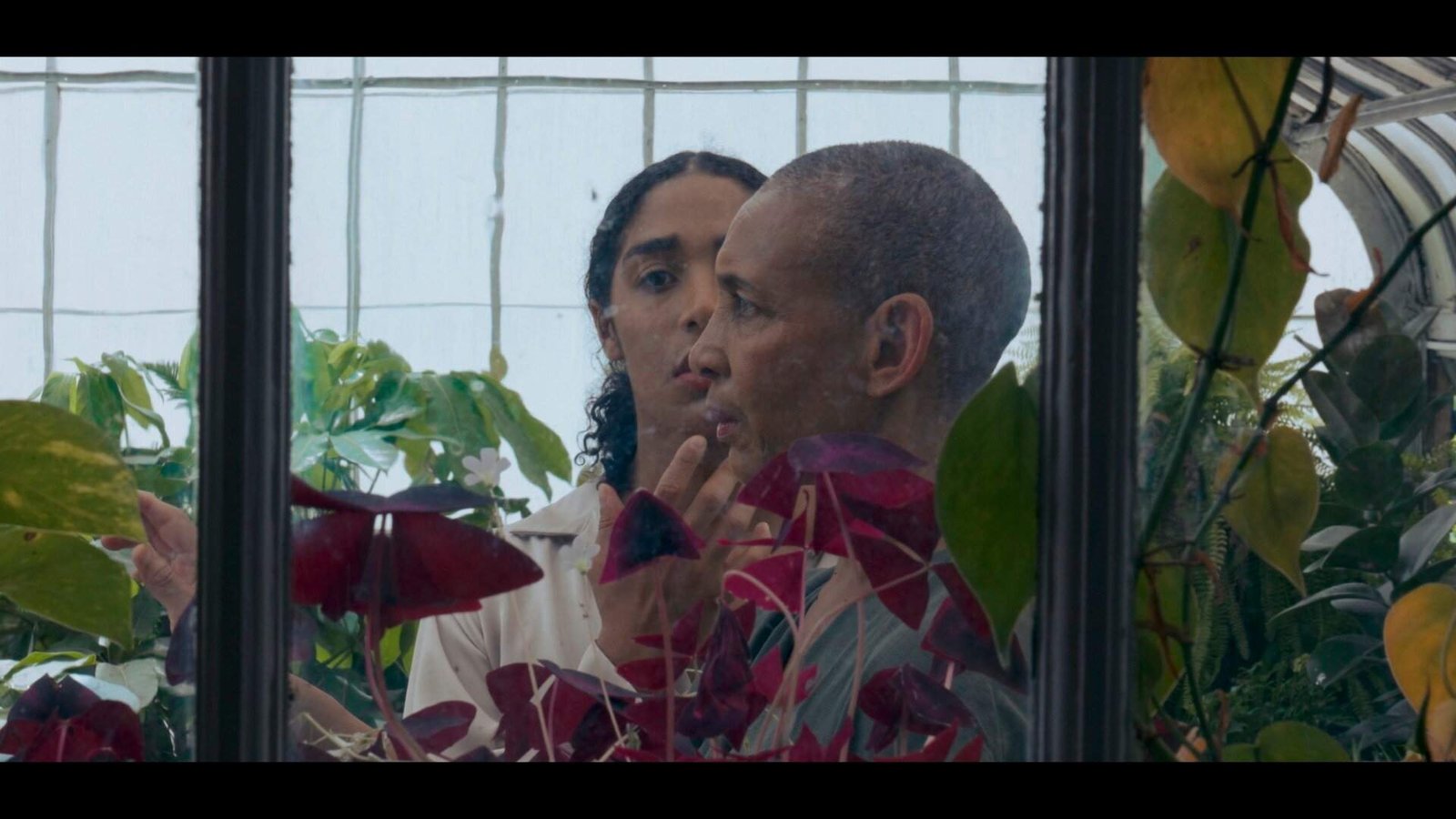
“The hands of the dancers are the hands of my mother and sister, the hands of our grandmother, the hands of their mothers.” These words of celebrated American poet Cornelius Eady serve as an anchor for the short film “Mercy” that weaves poetry and imagery, with gesture, movement and voice into an intricate meditation on black womanhood. Eady’s eponymous cycle of poems is informed by the writing of Phillis Wheatley, the first enslaved person in the American Colonies to publish a full-length volume of poems.
The poetic short, directed by Philip Szporer, voices issues of race, place, and identity, and dives into the double-voiced discourses of a particular Black literary tradition concerning the complication of the slave learning their captor’s language.
Two celebrated dance artists, Angélique WIllkie and Amara Barner, embody the poetry through the power of their presence.
I have been immersed in the world of Canadian dance, spanning dance arts, performance, journalism, education and film for over 40 years. I have presented artistic works internationally, speaking at artistic events and educational institutions as well as hosting workshops that promote the knowledge of dance and dance cinema. I am also a researcher and continue to mentor emerging artists.
In 2001 I co-founded Mouvement Perpétuel, a media arts production company based in Montreal, with Marlene Miller, and we have received numerous awards for our work there. Together, we co-directed and co-produced an acclaimed collection of documentaries, dance short films and installation works. These impressionist creations have been described as “a
deeply intimate tracing of the curvatures of the human experience.”
In 2018, I co-founded Dance+Words with Kathleen Smith, an initiative to disseminate ideas and facilitate discussions around dance and the movement arts. These projects reflect an intergenerational, inclusive, respectful, and curious attitude towards reflection and commitment to the Canadian dance scene.
I currently teach at Concordia University and in 2016 I was recognized with the Faculty of Fine Arts Excellence in Teaching Award. I have also been a researcher in residence at the Jacob’s Pillow Dance Festival in Massachusetts (2000-2016). In 1999, I was awarded a Pew Scholarship (National Dance/Media Project) from the University of California, Los Angeles and in 2010 I was honoured with the Jacqueline Lemieux Award awarded by the Arts Council of Canada.
I have also worked as a journalist for CBC Radio, for the radio magazine Aux Arts, etc. of Radio-Canada, as well as correspondent for The World (BBC/WGBH-Boston). My writings on dance have been published in The Dance Current, Tanz and Dance Magazine, among others. I have also contributed to academic essays and chapters in works such as Motion Pictures: Dance’s Duet with the Camera (Palgrave Macmillan), Envisioning Dance on Film and Video (Routledge) and The Oxford Handbook on Jewishness and Dance (Oxford University Press).
I was drawn to the work of Cornelius Eady, an artist who has never shied from matters of social justice and equity in his body of work. Eady continues to shape the landscape of American literature. We’ve also been friends for four decades. It was an honour to be given this opportunity to combine his poetry and movement in a film.
As a team we dove, through Cornelius’ guidance, into the double-voiced discourses of a particular Black literary tradition implicit in his poetry cycle which explores that period of time between the loss of Philiis Wheatley’s native West African tongue and its replacement with English. By consequence, we were investigating the issues and complications of race, place, and identity. Here’s what Cornelius wrote after our research process, prior to filming: “What has started out for me as a poetry cycle – a desire to try to understand the various strands in history that could make a Phillis Wheatley – has turned, thanks to these dancers and video camera, into a meditation on black womanhood. The hands of the dancers (Amara Barner and Angélique Willkie) are the hands of my mother and sister, the hands of our grandmother, the hands of their mothers. I was aware of how my lines, selected by the dancers, were used to connect their experience, their lives, to Phillis’. You can see it – what starts as language, becomes an unspoken bond between them, becomes the spark that cannot be ground out. Just as Wheatley found her way through, these dancers hold and carry the ache of wanting an ancestor to know her survival was a door and path for their own.”
|
country |
Canada |
|---|---|
|
runtime |
15:37 |
CREDITS
|
Director |
Philip Szporer |
|---|---|
|
Writer |
Philip Szporer |
|
Producer |
Marlene Millar |
|
Key Cast |
Angélique Willkie |
|
Director of Photography |
Pablo Córdoba Salcido |
|
Movement Director |
Ami Shulman |
|
Music Composer |
Devon Bate |
|
Sound Design |
Devon Bate |
|
Colour Grading |
Philip Szporer |